For athletes
HYROX & functional fitness race photography: shooting heats, stations, and the run
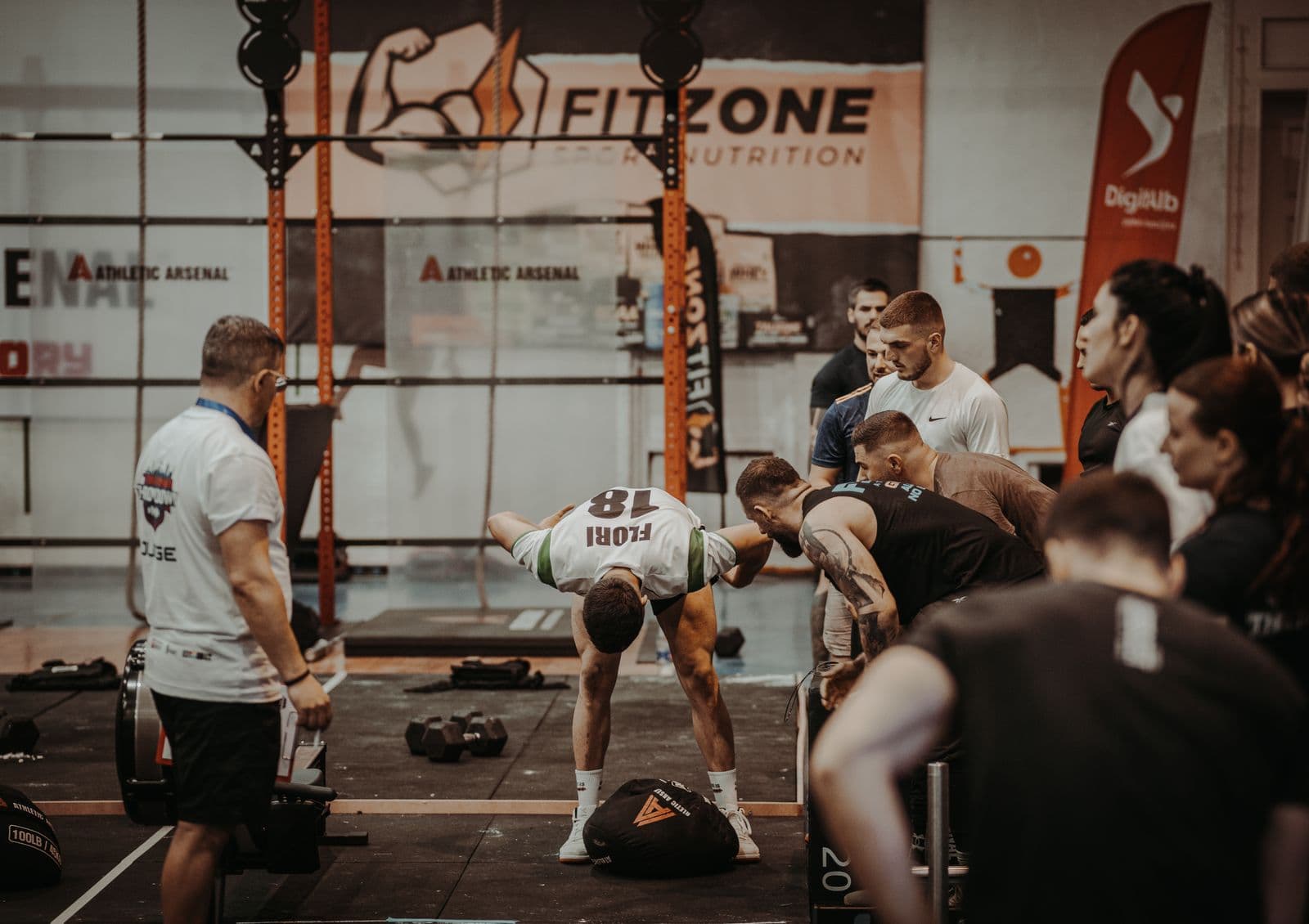
Dim arena light, heats rolling off every few minutes, and athletes half-hidden behind a sled or a wall of wall-balls. Functional-fitness racing is a genuinely hard photo environment. Here is how it’s shot, and how you find yourself across all of it.
On this page
HYROX and the wider world of functional-fitness racing (the indoor, station-based format where you alternate runs with functional workouts) have exploded. The photography has not kept up. Anyone who has raced one knows the feeling: you put in a brutal hour, and afterwards the photos are scattered, dark, or simply missing. That’s not bad luck. Indoor, heat-based racing is one of the hardest environments there is to photograph, for reasons worth understanding. (We use “HYROX & functional fitness” here descriptively to mean this style of event; PodiumBase is not affiliated with or endorsed by HYROX.)
Why indoor functional-fitness racing is hard to shoot
The light is working against you
Arenas, expo halls, and warehouses are lit for spectators, not cameras: low overall levels, harsh uneven pools of light, and colour casts from mixed sources. To freeze a sled push or a sandbag lunge in that light, a photographer has to push ISO high and shoot wide open, which trades away sharpness and adds grain. An outdoor finish line at midday is a gift by comparison; an indoor functional course is the opposite.
Heats roll continuously
These races send athletes off in waves, with a new heat starting every few minutes. That means the same eight stations and the same running lane are used over and over by different athletes all day. A photographer can’t just “shoot the finish” once. The finish happens dozens of times. And matching a photo to the right person by timestamp alone is genuinely error-prone, because the heat before yours and the heat after yours were doing the exact same thing in the exact same spot.
The stations hide the athlete
Functional stations are, by design, full of equipment. You’re behind a rower, buried under a sandbag, mid-burpee with your face to the floor, or screened by a stack of wall-balls. Your race number is creased, sweat-soaked, twisted, or completely obscured for large stretches. The most dramatic effort shots are often the ones where you’re least identifiable by any number.
There’s often no established photo platform
Road races have decades-old photo workflows. Functional-fitness racing is newer, and coverage is inconsistent: some events have a photographer, some rely on whatever spectators and partners capture, and the results land in scattered social galleries or never surface at all. There frequently isn’t a single, athlete-friendly place to go and find yourself.
How athletes find their photos across stations and runs
The common thread in every problem above (rolling heats, hidden numbers, scattered galleries) is that the photo can’t be reliably tied to you. Where the event, account, consent, age, and jurisdiction gates allow it, face matching can use a selfie to return eligible recognizable matches from covered functional stations and run splits, even when a sled blocked your bib and the heat clock was useless. On PodiumBase, start from the event’s photo page to see whether selfie search is available for your eligible account, consent, age, and jurisdiction. The selfie is deleted within 60 seconds of matching, and the one-time search does not retain a derived face signature (see our trust & safety page). Matching can work in low light and through partial obstruction when there is a clear enough view of your face in the frame.
Without face matching, you’re left scrolling a dim, mega-gallery full of near-identical heats, the slowest possible way to find yourself. (The general bib-free playbook is in how to find your race photos without a bib number.)
Practical tips for better functional-fitness race photos
- Find the camera between stations. The runs are your clearest, most upright, best-lit moments, when a photographer can actually see your face. Look up on the run-ins.
- Own the station that suits you. Sled push, ski-erg, and wall-balls give big, dramatic frames. A strong, deliberate rep as you spot a lens beats a hunched grind.
- Keep your number readable when you can. A flat bib helps traditional tagging on the runs, but assume it’ll be hidden at the stations, so don’t count on it for finding photos later.
- Wear something that reads in low light. A bright or distinctive top helps both the photographer and the matching engine pick you out of a dim, crowded floor.
- Check for selfie search afterward. Where event, account, consent, age, and jurisdiction gates allow it, a selfie can return likely eligible matches from covered stations and run segments without relying only on a heat estimate.
For race directors and photographers
If you run functional-fitness events, photos are a real gap: athletes work incredibly hard and often leave with nothing to show for it, because rolling heats and dim, station-heavy courses defeat ordinary tagging. Where event, account, consent, age, and jurisdiction gates allow it, a face-matching platform can help eligible athletes find likely published matches from covered stations as galleries become available; see how it works for race directors. And if you shoot these events, face matching can help eligible low-light station shots reach the right athlete instead of disappearing into an unsorted gallery; here’s the photographer side.
The short version
Functional-fitness racing is hard to photograph because of low light, rolling heats, and stations that hide you, and because there’s often no proper photo platform behind it. Where event, account, consent, age, and jurisdiction gates allow it, selfie search can return likely eligible published matches from covered stations and run segments. Find my race photos to check availability for your event.
Questions
How do I find my photos across all eight stations and the runs?
Where event, account, consent, age, and jurisdiction gates allow it, selfie search can return likely eligible matches from covered stations and run segments, reducing the need to hunt station by station.
Why are indoor race photos often darker or grainier?
Arena and warehouse venues have low, uneven, often colour-shifted light. Photographers shoot at high ISO and wide apertures to freeze fast movement, which can add grain. Good event coverage plans for this with positioning and lighting, but it is inherently harder than an outdoor finish line.
I raced in a later heat: will my photos be mixed up with another heat’s?
Rolling heats can confuse timestamp-and-station guessing. Where event, account, consent, age, and jurisdiction gates allow selfie search, it can return likely eligible matches keyed to your face instead of relying on the heat clock alone.
A station was blocking me in half the shots: can I still be found?
Potentially. Where event, account, consent, age, and jurisdiction gates allow selfie search, a clear enough view of your face may still produce a likely eligible match even when equipment hides your number.
Is there an official photo platform for these races?
Coverage varies by event and venue, and many functional-fitness races have no established, athlete-friendly photo platform. Galleries are scattered or slow. When an event publishes its coverage to one face-matching gallery, athletes can search all of it at once; photos posted only elsewhere are not included.
Raced a supported indoor fitness event? Check whether selfie search is available for your eligible account, consent, age, and jurisdiction.
See functional-fitness photo coverage